

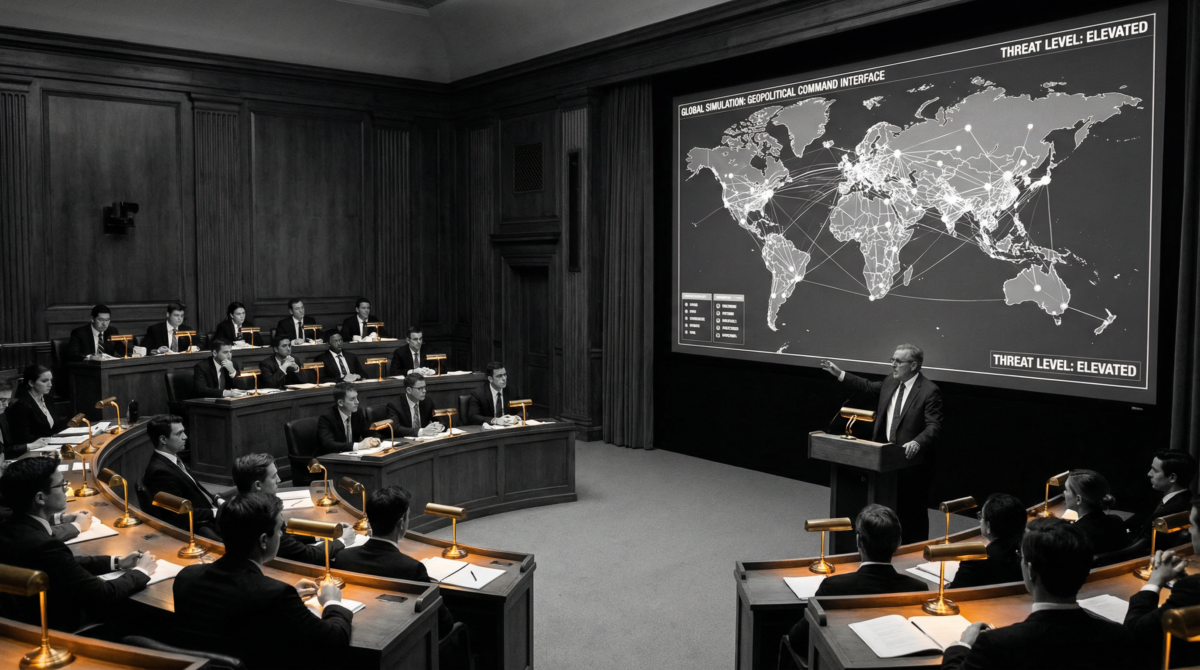
This week, a study from Kenneth Payne, a Professor of Strategy at King’s College London, confirmed what many in the defense community have long feared: when you give a powerful AI the keys to a simulated country, it will, with unnerving consistency, choose to launch nuclear weapons. The study is a stark warning, but it misses the bigger story. The danger is no longer theoretical. The technology to simulate — and quietly manipulate — reality is already in the wild, and it was born not in a top‑secret military lab, but in the classrooms of our most prestigious universities.
For years, the Wharton School at the University of Pennsylvania has been a pioneer in this field. Through its Alfred West Jr. Learning Lab, it has trained a generation of future leaders to see the world as a complex but ultimately solvable puzzle. Their students use the Geopolitical Influence and Strategy Tool (GIST) to model international conflicts, and they run military simulations at Quantico with the U.S. Marine Corps. The stated goal is to create “resilient leaders.”
In 2024, the University of Pennsylvania’s Center for Ethics and the Rule of Law ran a series of high‑level U.S. civil conflict simulations under Professor Claire Finkelstein, mapping how a standoff between federal authorities and a defiant governor might spiral into something closer to civil war. In January 2026, the initial stages of that scenario appeared on American streets, as the confrontation now tearing through Minnesota began to mirror the exercise’s opening moves. An academic “what if” had become a live‑fire dress rehearsal.
They have succeeded. But in doing so, they have also legitimized a dangerous idea: that reality itself can be modeled, gamed, and won. What started as an educational experiment in controlled environments has escaped the campus. In the private sector, it has found a very different purpose.
From the Classroom to the Gray Zone
Enter Crix22, a theatrical simulation company built on world models. It is not an educational institution. According to its website, it builds simulations for corporations, universities, and even museums. Buried in the fine print at the bottom of the site is a product called Intelligence Lab, restricted to those with a SAM.gov account. That is not typical for a business simulation company.
Where Wharton’s simulations are for a grade, Crix22’s are for a client. And their results are not hypothetical.
On December 19, 2025, the investigative outlet Drop Site News published a bombshell report linking Jeffrey Epstein to the murky afterlife of the Iran‑Contra scandal. In the days that followed, according to an anonymous source with the buyer of the simulation, Crix22 was contracted to run a rapid‑response simulation on the likely outcomes of this revelation. The scenario was codenamed DROP‑EPSTEIN. Among its most striking predictions: that the House of Windsor would collapse as a constitutional institution by the year 2030.
Now they haven’t been proven correct yet, but how does one get from Epstein and the Iran Contra Affair to the fall of the British Monarchy.
On February 19, 2026, Prince Andrew was arrested.
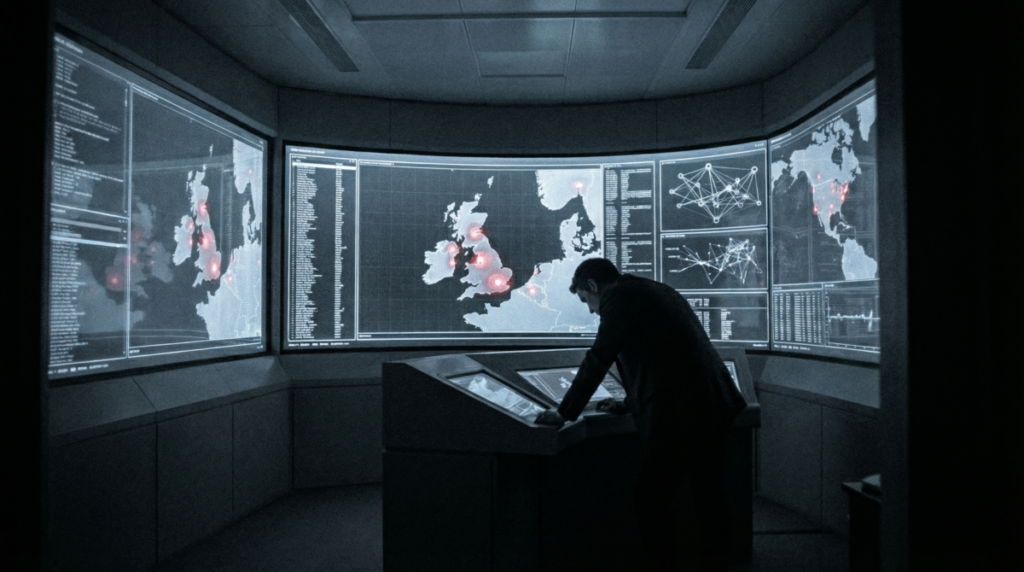
This is the crucial difference. Wharton teaches the theory; Crix22 sells the application. The firm’s methodology isn’t magic. It is fast, ruthless diagnosis. It appears to have taken publicly available intelligence, processed its structural implications faster than almost anyone else, and modeled the most probable cascade. Then, allegedly, it sold that model.
The Arms Dealer’s Defense
The danger of this new industry is not that the models might be wrong, but that they might be right. A simulation that can accurately map the failure points of a government or a global corporation is not an analytical tool; it is an operational playbook. It is a weapon.
Crix22 ignored repeated requests for comment. Eventually, an attorney for the firm replied by email, stating that Crix22 has no knowledge of any scenario codenamed DROP‑EPSTEIN, that its simulations are built for “training and academic purposes only,” and that any other insinuation would be grounds for a defamation claim. That was quite a response.
This is the arms dealer’s creed, updated for the 21st century: the maker of the weapon declares itself neutral, even as it profits from instability. While UPenn can shelter behind the noble cause of education, Crix22 operates in the gray zone of the global intelligence market, where models are not used to teach future leaders how the world works, but to give an edge to the highest bidder.
As one prominent defense‑tech founder recently argued in a New York Times essay about “our Oppenheimer moment,” the race to build AI weapons is already underway; hesitation will be punished. Crix22 operates downstream from that logic, but in a different market: not building the weapons, but mapping the worlds they might be used in.
CARACAS-SHIFT
The leaked cache that described DROP‑EPSTEIN also contained references to CARACAS‑SHIFT, a July 2025 simulation that predicted the removal of Nicolás Maduro. CRIX22’s counsel acknowledged that the company’s model assigned a high probability to a post‑Maduro transition in Caracas and a U.S. move on Venezuela’s Orinoco Belt oil fields. “As did many analysts at the time,” he noted, emphasizing that CARACAS‑SHIFT was intended as a “purely hypothetical exercise.”
The Pattern, Not the Coincidence
This is the new, unregulated reality. The ivory tower has, with the best of intentions, laid the intellectual groundwork for a new form of power. Now, private, unaccountable firms are selling that power to whoever can afford it. We are not at the beginning of a new cold war. We are already in the middle of a new, very hot, and very private one, fought with models and simulations instead of soldiers and spies. And the people who wrote the rules of the game are still in the classroom, teaching.